You spend hours every week on Instagram, TikTok, and LinkedIn, but when you look at your bank account, it is hard to tell if those posts are actually paying the bills. Most small business owners treat social media like a digital billboard they hope people see, rather than a precision tool for revenue growth. This uncertainty leads to wasted hours and drained budgets on platforms that might not be moving the needle.
Calculating the financial return of your digital presence is not just a task for big corporations with massive data teams. In 2026, small businesses have access to tools and frameworks that make measuring marketing return simpler than ever. This guide shows you exactly how to measure your social media financial impact so you can stop guessing and start scaling what works.
Table of Contents
The True Definition of Social Media ROI in 2026
Social Media Return on Investment (ROI) is the measure of the efficiency of a social media marketing campaign. It represents the value you get back from the time, money, and resources you put into social platforms. While many people focus on likes and followers, these are often just vanity metrics that do not correlate with profit.
To see real success, you must understand Why Data Oriented Marketing Strategies Succeed Where Creative Tactics Fail. A creative post might get thousands of views, but if those viewers do not buy your product or sign up for your newsletter, the ROI is effectively zero. In 2026, ROI is no longer about general brand awareness; it is about specific, attributable revenue. Small businesses must shift their mindset from being content creators to being data-driven marketers who view every post as a financial asset.
Defining Your Objectives and Key Performance Indicators
You cannot calculate a return if you do not know what you are looking for. Every small business marketing budget must be tied to specific objectives. These objectives should be SMART: Specific, Measurable, Achievable, Relevant, and Time-bound.
Common objectives for small businesses include:
Once you have your objectives, you need Key Performance Indicators (KPIs). If your goal is sales, your KPI is the conversion rate. If your goal is leads, your KPI is the cost per lead. Understanding 5 Facebook Ad Metrics You Are Ahead of 90 Percent of Pros can help you focus on the numbers that actually dictate your profit margins.
The Standard Formula for Social Media ROI
The basic math for calculating ROI is straightforward. However, the difficulty lies in ensuring you have the correct numbers to plug into the equation.
The Formula:
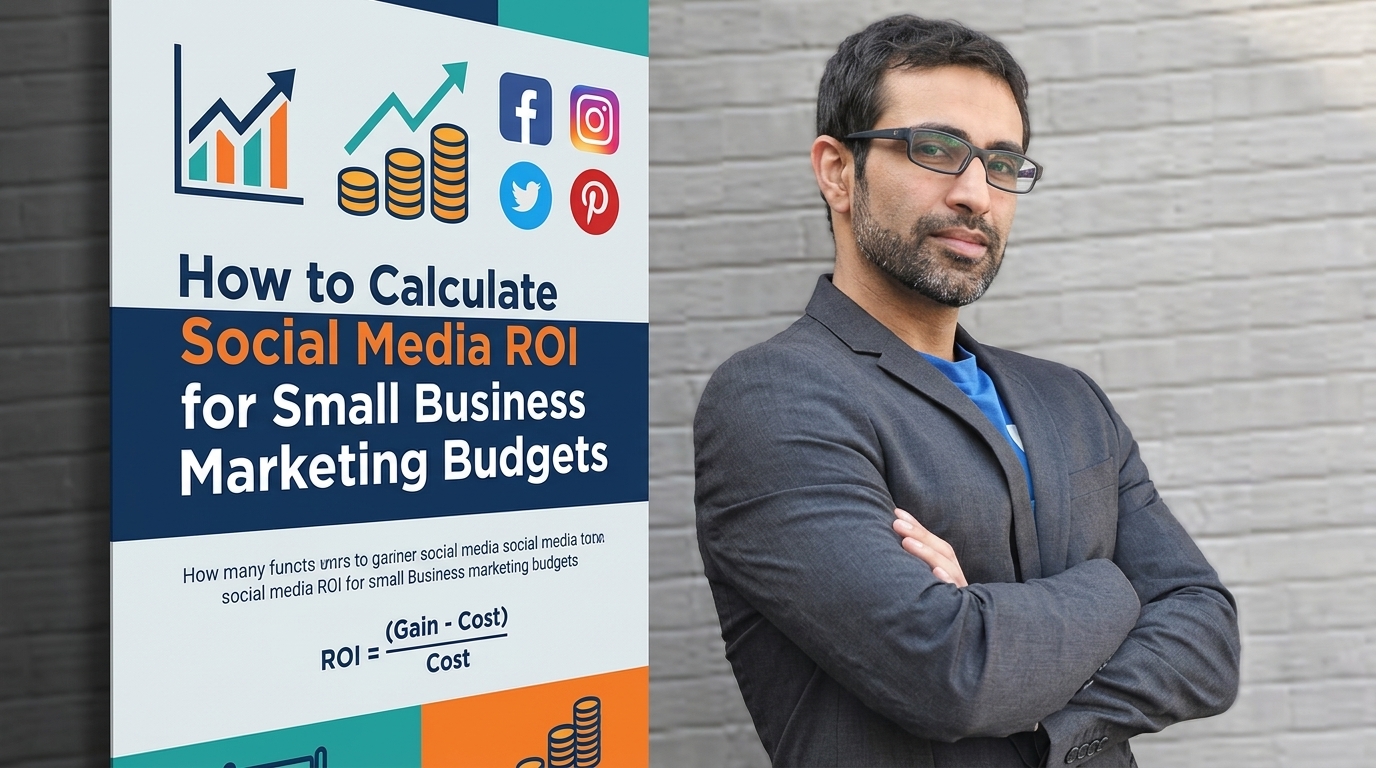
(Total Revenue – Total Investment) / Total Investment x 100 = ROI %
For example, if you spend $1,000 on a Facebook ad campaign and it generates $3,500 in sales, your calculation would look like this:
($3,500 – $1,000) / $1,000 = 2.5
2.5 x 100 = 250%
This means for every dollar you spent, you earned $2.50 in profit back. For small business owners, maintaining a positive ROI is what allows for the reinvestment of profits into larger campaigns. If your ROI is negative, it means you are losing money on that specific channel and need to adjust your strategy or targeting.
Identifying Total Investment Beyond Ad Spend
One of the biggest mistakes small businesses make is only counting their ad spend as their investment. This leads to an inflated and inaccurate ROI. To get a true sense of your social media financial impact, you must include all costs associated with your social media efforts.
Labor Costs
Whether you are doing it yourself or paying an employee, time is money. Calculate the hourly rate of the person managing the accounts and multiply it by the hours spent on social media each month.
Content Creation
This includes the cost of photographers, videographers, graphic designers, or software subscriptions like Canva or Adobe Creative Cloud. If you buy stock photos or hire a copywriter for your captions, those costs must be added to the “Total Investment” bucket.
Tool Subscriptions
Are you using a scheduling tool like Buffer or Hootsuite? Are you paying for an AI tool to help with your captions? These monthly fees are part of your marketing overhead. If you are trying to decide which tool is worth the cost, check out this Buffer Vs Hootsuite Pricing And Features Comparison For Small Business Teams.
Measuring the Financial Value of Conversions
Not every social media interaction ends in a direct sale. Sometimes, a customer might click an ad, sign up for an email list, and then buy a product three weeks later. This is where attribution models become important.
To calculate the value of a non-sale conversion (like a lead), you need to know your average conversion rate from lead to customer.
By assigning a dollar value to actions like newsletter sign-ups or whitepaper downloads, you can prove the value of your organic content strategy even when it doesn’t lead to an immediate checkout.
Using Analytics Tools for Precise Tracking
To get these numbers accurately, you cannot rely on the native analytics provided by social media platforms alone. They often use “last-click” attribution which might ignore the complex journey a customer takes before buying.
Google Analytics 4 (GA4) is currently the industry standard for small businesses to track how social traffic behaves on their website. It allows you to set up conversion events and track the exact source of every visitor. If you are active on Instagram, it is helpful to learn How to Use Google Analytics 4 to Track Your Instagram ROI Without Mistakes so you can see which specific links in your bio or stories are driving revenue.
Using UTM parameters is also a non-negotiable practice. A UTM parameter is a simple code you add to the end of a URL so GA4 can tell you exactly which post or campaign the traffic came from. Without them, your social traffic might get lumped into a general “Direct” or “Referral” category, making it impossible to calculate ROI for specific campaigns.
Comparing ROI Tracking Tools for Small Businesses
Different businesses have different needs based on their technical skills and budget. Here is a comparison of common tools used to measure social media financial impact in 2026.
| Tool | Best For | Key ROI Feature | Pricing Level |
|---|---|---|---|
| Google Analytics 4 | Website Tracking | Path exploration and conversion funnels | Free |
| Sprout Social | Enterprise Analysis | Paid and organic integration reports | High |
| Hootsuite | Multi-channel Management | Impact reporting with revenue attribution | Medium |
| Triple Whale | E-commerce (Shopify) | First-party data tracking for ads | Medium/High |
| Google Gemini | Data Interpretation | Analyzing CSV exports to find patterns | Free/Paid |
Using AI to Simplify ROI Calculations
In 2026, you don’t need to be a math genius to handle your marketing data. Generative AI models like Google Gemini can help you process your analytics data and provide insights that would take a human hours to find. You can export your social media performance data into a CSV file and ask the AI to calculate your ROI or identify which content types have the lowest cost per acquisition.
Here is a prompt you can use to help you analyze your data:
Total Spend: [Insert Amount]
Total Leads: [Insert Number]
Closing Rate: [Insert %]
Average Customer LTV: [Insert Amount]
Calculate the total ROI and tell me which channel is performing best based on the cost per lead. Suggest three ways to improve the ROI based on this data.